
Garage Door Safety Sensor Test: How to Check Your Photo Eyes and Auto-Reverse
An automatic garage door is the heaviest moving object in most homes. The safety system that stops it from closing on a child, a pet or a bumper is simple, and it takes about five minutes to check. The U.S. Consumer Product Safety Commission advises testing it monthly. Most people never do.
This guide walks through a homeowner safety sensor test, what the federal opener standard requires, and what to do if your door fails. It applies to any home in Garland, Texas or nearby cities. It doesn't cover spring or cable work, which belongs to a trained technician.
What the federal standard requires
Residential garage door openers manufactured on or after January 1, 1993 for sale in the United States must meet the federal entrapment protection standard, 16 CFR Part 1211. Two parts matter for a homeowner:
- Auto-reverse on contact. A closing door's opener must start to reverse within 2 seconds of contact with an obstruction.
- A second, backup safety system. The opener also needs a secondary means of protection. Photo-eye sensors near the floor are the most common, but edge sensors on the bottom of the door, or a wall control you must hold down for the door to close, can also meet the standard.
So the rule isn't "every door must have photo eyes." It's that a post-1993 opener must reverse on contact and have a backup system, and photo eyes are the usual way manufacturers provide it. Openers made before 1993 weren't built to this standard. If your opener is that old, see our guide to old garage door openers in older Garland homes.
The CPSC adopted these protections after it identified dozens of child deaths involving garage doors in the 1980s. The test below checks that both protections still work on your door.
Before you start
Keep children and pets out of the garage during the test. Stand clear of the door's path and keep your hand near the wall button so you can stop the door. Don't touch springs, cables or the brackets at the bottom corners of the door. Torsion springs store enough energy to cause serious injury.
How to test your garage door safety sensors
This is a basic homeowner check. Your opener's manual may describe the same test with slightly different steps, so follow it if you have it.
Look at the sensors
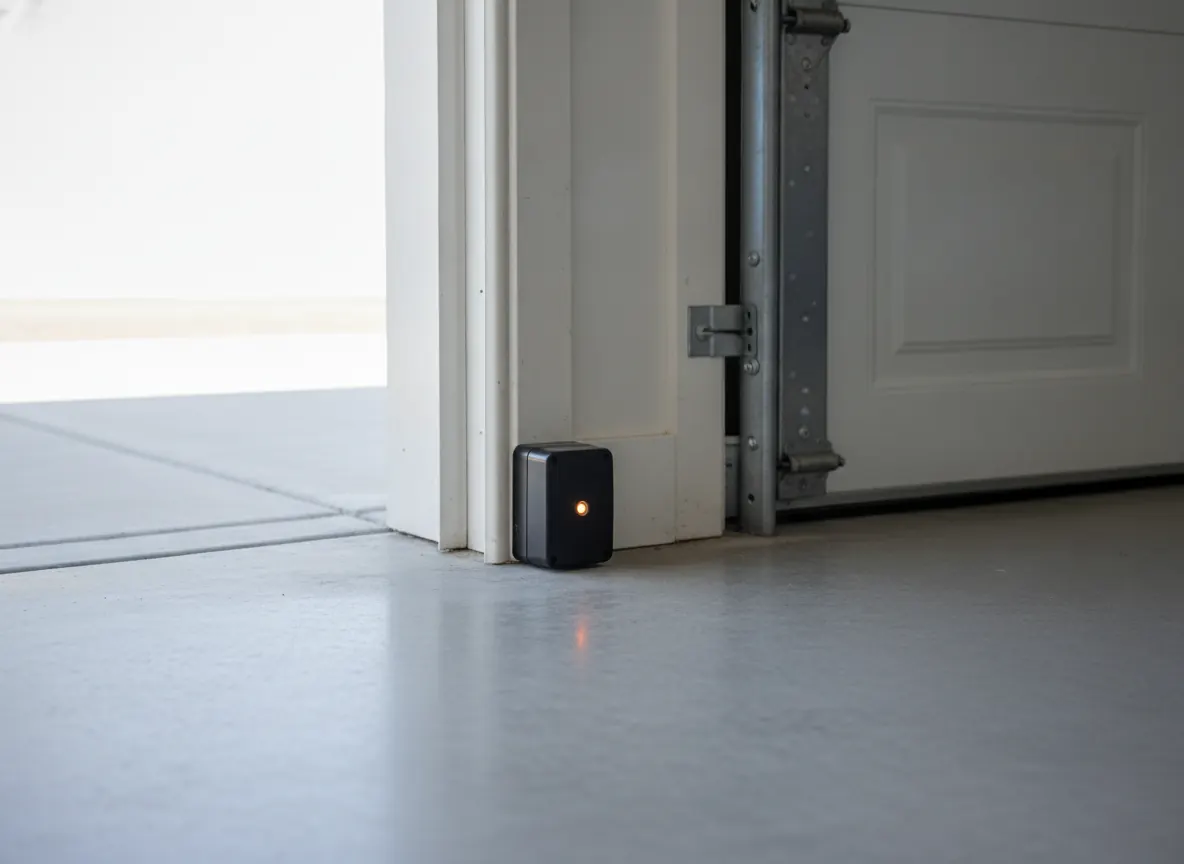
Find the two small photo eyes on each side of the door opening, usually a few inches above the floor. Check that the lenses are clean, the brackets aren't bent, and the indicator lights are on. On many openers one light is steady and the other blinks or goes out when the beam is blocked or misaligned.
Test the photo eyes
Open the door fully. Press the wall button to close it, then pass an object such as a broom handle or a cardboard box through the beam while the door is coming down. Don't use your hand, foot or body. The door should stop and go back up.
Test auto-reverse on contact
Open the door again. Lay a flat, sturdy object on the floor in the center of the opening where the door meets the ground. A piece of 2x4 lumber laid flat is a common choice. Close the door. When it touches the board, it should stop and reverse within about 2 seconds.
Watch the return
After it reverses, the door should travel back to the open position smoothly. Remove the board and close the door normally to confirm it seals at the floor.
Write down the date
Note the date on your calendar or phone and repeat it next month. The CPSC's advice is monthly testing.
What a failed test means
| What happened | Common reasons | What to do |
|---|---|---|
| Door kept closing when the beam was blocked | Sensors bypassed, wired wrong, or the opener predates photo eyes | Stop using the automatic close and request a sensor or opener check |
| Door crushed the board instead of reversing | Force or travel settings off, a binding door, or a worn opener | Stop using the automatic close; have a technician check the door and opener together |
| Door won't close at all; lights blink | Dirty lens, misaligned bracket, damaged wire, or direct sun on a lens | Clean the lenses and check alignment; if it continues, request a repair quote |
| Door reverses for no reason | Something in the beam, loose bracket, or a door that's binding in the track | Clear the path and look for obvious obstructions, then get it checked |
Two things not to do: don't tape or tie the sensors together to "make it close," and don't turn up the opener's force setting to push through a door that's binding. A heavy, hard-to-move door usually points to a spring or balance problem. That's work for a technician, not a setting to override.
Low afternoon sun can shine straight into a lens on west-facing garages and cause intermittent faults. If the problem only shows up at certain times of day, mention that when you request quotes.
When the fix is a sensor, and when it's the opener
Many failed tests come down to the sensors: a bumped bracket, a cut low-voltage wire, or a worn sensor pair. A failed contact-reverse test can be a door problem instead. A door with worn rollers, a weak spring or a bent track can bind on the way down, and the opener may read that as normal resistance.
That's why it helps to have the door and opener looked at together. Our safety sensor and auto-reverse repair page explains what technicians typically check, and the garage door opener repair page covers when an older opener is worth replacing. For published price ranges, see the garage door repair cost guide for Garland, TX.
New opener? Check the wiring plan
Sensors and wall buttons use low-voltage wire. If a new opener needs a new ceiling outlet or circuit, that electrical work requires a Texas-licensed electrician. Ask the company quoting the opener how that part will be handled.
Questions to ask the company that fixes it
- Will you run the photo-eye and contact-reverse tests in front of me after the repair?
- Is the problem the sensors, the opener, or the door itself?
- What's the trip fee, and will I get a written estimate before work starts?
- Which parts are you replacing, and will they be listed on an itemized invoice?
- What warranty terms apply to the parts and labor, in writing?
To compare prices, request free quotes from independent local companies serving Garland, TX, or call (877) 265-2390. Garland Garage Door Experts is a free quote service, not a garage door company.
Frequently asked questions
How often should I test my garage door safety sensors?
Once a month. The U.S. Consumer Product Safety Commission advises monthly testing of automatic garage door openers. Test both the photo eyes, by breaking the beam with an object while the door closes, and auto-reverse, by letting the door touch a flat board on the floor.
Are garage door photo eyes required by law?
Not exactly. Openers made since January 1, 1993 must reverse within 2 seconds of contact and have a secondary safety system under 16 CFR Part 1211. Photo eyes are the most common way to meet that, but edge sensors or a hold-to-close wall control can also comply.
Why won't my garage door close when the sensor light is blinking?
A blinking sensor light usually means the opener thinks the beam is blocked. Common causes are a dirty lens, a bumped bracket that throws the eyes out of line, a damaged wire, or bright sun hitting a lens. Clean and check the sensors; if it keeps happening, have them checked.
Can I keep using my door if it fails the auto-reverse test?
It's safer not to close it automatically until it's checked. A door that doesn't reverse can injure someone or damage a car. Keep people and pets clear, and request a repair. Don't raise the opener's force setting to make a binding door close.